If you’re new to Korea, learning how to use a Korean convenience store properly will make daily life so much easier.
Convenience Store Basics: A Quick Korean Convenience Store Guide
Most convenience stores in Korean cities aim to stay open 24 hours a day. (In smaller towns or quiet neighborhoods, some may close late at night depending on the owner — but this is the exception, not the rule.)
Inside, you’ll find triangle kimbap (samgak-gimbap), ramyeon, cup noodles, drinks, alcohol, snacks, bread, and daily necessities. For anything that needs to be heated — like triangle kimbap or a boxed meal (dosirak) — there’s a microwave available in-store, and for cup noodles, you can fill them with hot water from a dispenser.
Heating instructions are printed right on the packaging, but as a general rule:
- Triangle kimbap: microwave for about 30 seconds without removing the plastic wrap
- Boxed meals (dosirak): remove the plastic wrap and lid, then microwave for about 1 minute 30 seconds
A note on safety: Korea is an extremely safe country, so going to a convenience store alone late at night is completely normal — not something to worry about.
A Few Rules to Know
- Drinking alcohol inside the store — or on the outdoor terrace — is not allowed. This is the basic rule everywhere.
- Convenience stores are especially popular with students (elementary through university) looking for a cheap, fast meal, or a quick snack while studying.
The Big Three Brands
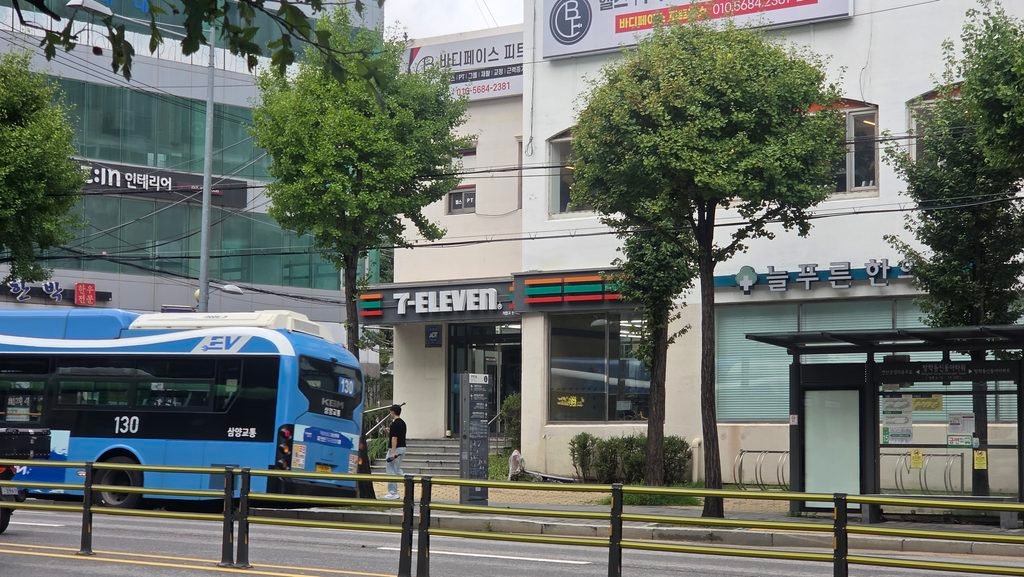
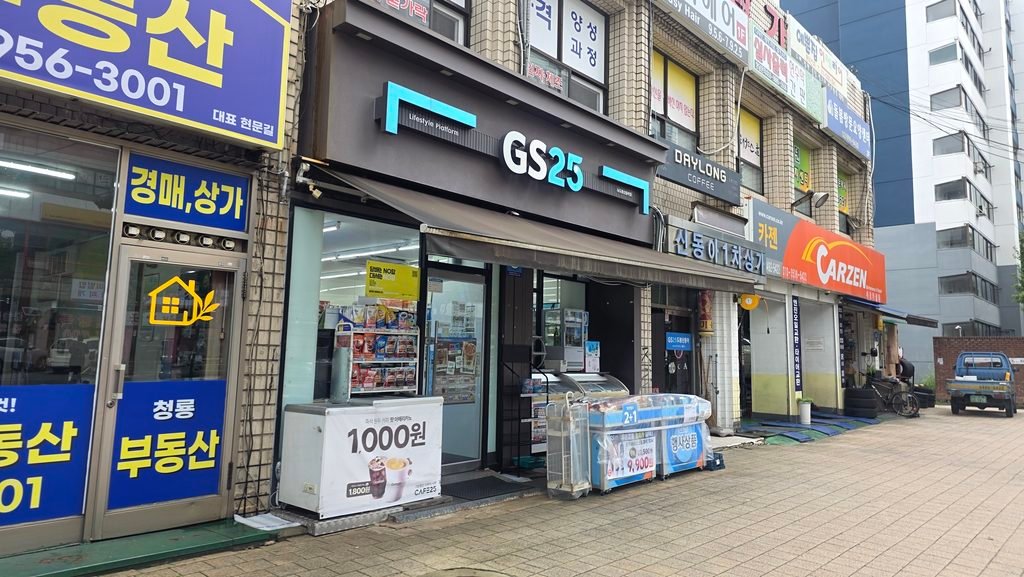
The three brands you’ll see the most are 7-Eleven, CU, and GS25. Honestly, the products are fairly similar across all three — there’s no huge brand-specific advantage. That said, each brand runs its own occasional promotions, and some locations sell freshly-made snacks like fried skewers at the counter.
ATMs and Package Delivery
Not every store has an ATM, but they’re common enough that you’ll usually find one within 2–3 tries.
You can also send packages from convenience stores — CU is the most commonly used for this. GS25 offers a service called “banggap-taekbae” (반값택배, literally “half-price delivery”): if you set your nearest GS25 as the pickup location, you can cut your delivery cost in half. Pricing depends on weight.
My honest tip: for anything heavy or valuable, go to the post office instead. For lighter, everyday packages, a nearby convenience store works great. Just know that boxes and tape aren’t provided — you’ll need to pack everything at home before you go. And if the process feels confusing, most Korean staff are genuinely happy to help — a translation app can bridge the gap quickly.
More Than Just Snacks
Convenience stores also carry small daily essentials — socks, underwear, hair ties, shampoo — and basic over-the-counter medicine like painkillers, cold medicine, and digestive aids. Since there’s almost always a store within walking distance of any home in Korea, you can solve most small problems the moment they come up.
Apps, Points, and a Very Clever GS25 Feature
Each major brand has its own app where you can check promotions and earn points. Personally, I — and most people I know — don’t use these systems that much. But one GS25 app feature is genuinely worth knowing: with certain 1+1 (buy-one-get-one) deals, you can save your free item in a virtual fridge inside the app, then redeem it later at any GS25 location nationwide, completely free.
What Locals Actually Use Convenience Stores For
Realistically, most Koreans stop by for a quick meal (ramyeon, kimbap), or to grab cigarettes or alcohol. Not every store has seating, so if you’re planning to eat there, check for a table before you buy. Chopsticks and small straws are available at the counter — just ask.
After eating, you’re expected to sort your trash into general waste, recyclables, and food waste. Please take this seriously — store owners deal with a lot of stress over improperly sorted food waste.
My Go-To Combo (Try This)
My favorite combination: Buldak Bokkeum-myeon (spicy fire noodles) cup ramyeon with cheese, paired with a tuna mayo triangle kimbap. Buldak is famously spicy, but the cheese cuts through the heat, and the tuna mayo kimbap helps balance it even more — so you get the flavor without getting overwhelmed.
Most popular cup ramyeon among Koreans, in order:
- Shin Ramyeon
- Jin Ramyeon
- Buldak Bokkeum-myeon
- Jjapaguri (Chapagetti)
If you’re not sure where to start, try one of these. If you’d rather avoid the heat, go for:
- Jin Ramyeon Mild (blue lid)
- Jjapaguri (Chapagetti)
- Chamkke (sesame) Ramyeon
- Tempura Udon Ramyeon
Don’t skip dessert. Korean convenience stores genuinely do this well — I’d recommend anything from the Yonsei Cream Milk Bread line (연세우유 생크림빵). It’s honestly richer and tastier than a lot of what you’d get at an actual bakery. These are usually shelved right next to the triangle kimbap section, so don’t miss them.
A Few More Money-Saving Tips
If you’re not picky, go for the 1+1 or 2+1 discounted items. Convenience stores are typically priced about ₩100–500 higher than a regular supermarket, so leaning into the deals makes a real psychological (and actual) difference.
One more thing that makes life here easy: delivery apps like Baemin and Coupang Eats let you order convenience store items straight to your door. Between 24-hour stores on every corner and delivery apps that reach them, it’s honestly hard to run into a situation in Korea where you can’t get what you need.